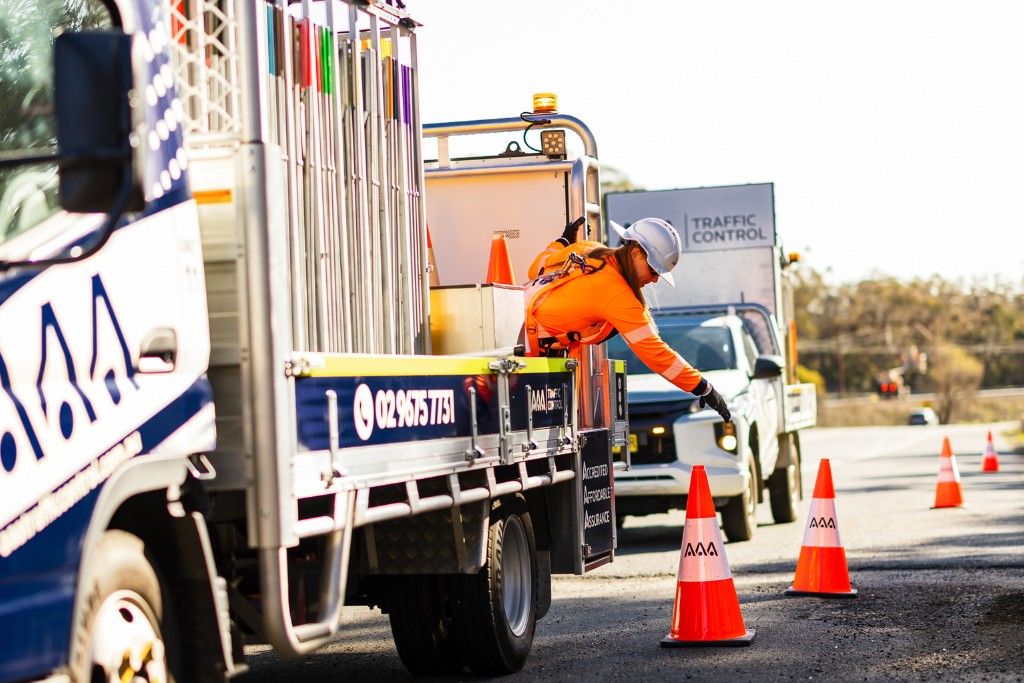
Today, traffic control management in Sydney is governed by some of the most rigorous standards. The best practices are now defined by a shift toward digital-first integration, stringent safety protocols and mandatory sustainability standards.
Let’s understand how these help you in traffic control management and planning.
1. Regulatory Framework & Documentation
Everything begins with the TfNSW Traffic Control at Work Sites (TCAWS) Manual. It’s the baseline for how work should be planned and delivered along with site-specific solutions.
- You must know that a Traffic Guidance Scheme (TGS) must reflect the exact physical road geometry.
- If your plan misses even a newly-made cycleway or the updated bus lane timing, it can turn into a liability.
- These plans must also be drafted and signed off only by a certified Traffic Management Designer (TMD). It is because council rangers and TfNSW inspectors now cross-reference these accreditations in real-time.
2. High-Stake Environments
Some sites don’t give anyone a second chance. High-speed roads, tight urban corridors, and school zones all fall into that category.
In these environments, small mistakes can have serious consequences, and that is precisely why:
- Creating DDA-compliant (Disability Discrimination Act) walkways is one of the key practices here.
- Utilising Truck Mounted Attenuators (TMAs) is mandatory for high-speed motorway work to prevent fatal workplace incidents.
3. Strategic Planning & Approvals
Sydney’s 30 Local Government Areas (LGAs) means your planning must start weeks in advance. Best practices here are primarily about aligning.
And that includes:
- Allowing for longer, more realistic taper lengths instead of relying on minimums.
- Ensuring cyclists are accommodated, either through protected lanes or properly managed detours.
- Coordinating with both councils and TfNSW so nothing causes a hindrance during the implementation stage.
4. Stakeholder & Community Engagement
Perhaps the most critical aspect of traffic control planning… It’s all about people. That is why maintaining a ‘Social Licence to Operate’ is considered as an unspoken component of professional traffic management.
Here:
- Direct coordination with the TfNSW Transport Integration team is mandatory if works affect bus routes.
- Best practice in this case involves notifying them at least 14 days prior to any stop relocation.
- For residential areas, distributing formal notification letters 7 to 10 days in advance is the industry benchmark.
- Our team considers this critical because this proactive approach avoids site shutdowns due to community complaints.
5. Psychosocial Safety & Public De-escalation
One thing that’s rarely even discussed is how much pressure traffic controllers deal with on the ground every hour.
With congestion, drivers tend to be impatient, and situations can escalate quickly. Knowing how to handle those moments calmly is just as important as understanding the traffic control plan.
To address this, the best practices include:
- Expert training in de-escalation and clear communication.
- This is a bulwark of an experienced traffic management team in Sydney.
- Working with teams that hold TfNSW G10 prequalification.
6. Ensuring High Standards
Lastly, it’s also worth checking that your traffic management provider holds relevant ISO certifications.
Some of the most credible ones include:
- ISO 9001 for quality
- ISO 14001 for environmental management
- ISO 45001 for safety
The reassuring news is that at AAA Traffic Control, our dedicated efforts stay on top of these certifications and even any emerging ones.
A Quick Checklist To Help You Decide
We’ve discussed the best practices but nothing is worth just on paper if it’s not visible… on the road.
Here’s what you must check when finalising a traffic control management company in Sydney:
- Start by enquiring whether the traffic management consultant is TfNSW G10 prequalified and working under recognised ISO systems (quality, environmental, and safety). This tells you whether their processes have already been audited.
- Verify that your traffic management consultant can handle everything from TMPs and TGS to permits, and that they have emergency response capabilities ready at all times.
- Ask how they deal with approvals. An experienced team can guide you through ROLs, council permits, and transport authority requirements.
- Understand their on-ground capability. This includes the presence of accredited traffic controllers and in-house equipment.
- See how prompt and comprehensive their communication is. You want a team that explains timelines, flags risks early, and keeps you updated without the complicated jargon.
- Finally, ask about their experience across different job types. The more varied their work, the better. This must cover construction dues and public events with a heavy footfall.
If a provider can confidently strike out all of these, you have a traffic control management expert who knows how to keep your site compliant, safe, and running smoothly. And this is exactly what our fully accredited team at AAA Traffic Control delivers.
We ensure safe passage of heavy machinery to your site, safety in community events, and even compliance requirements from government bodies. That’s not all, we have now moved beyond cones to strike out these boxes for you.
Dial (02) 9675 7731 to know how we do it.
FAQs
Q. What are the penalties for working without a valid permit?
As of 2026, corporations can face on-the-spot fines exceeding $22,000 per day, and site supervisors can be held personally liable. It can also lead to an immediate ‘blacklist’ from future government tenders.
Q. What is a TMD, and why do I need one?
A Traffic Management Designer (TMD) is the only person qualified to sign off on a traffic plan. Using a plan not signed by a TMD is a breach of the TCAWS standards and will be rejected by auditors.
Q. How do you manage school zones during the morning rush?
We can implement a high-visibility ‘pedestrian-first’ strategy. This involves extra spotters and holding site machinery until the peak drop-off window has passed.
Q. What if my project crosses two different council areas?
We coordinate a Lead Council agreement. This prevents you from being caught in a loop of conflicting requirements and ensures one unified plan covers the entire site.
Stay Updated with AAA Traffic Control
Make AAA Traffic Control a preferred source on Google for relevant traffic management insights, industry updates and useful information.