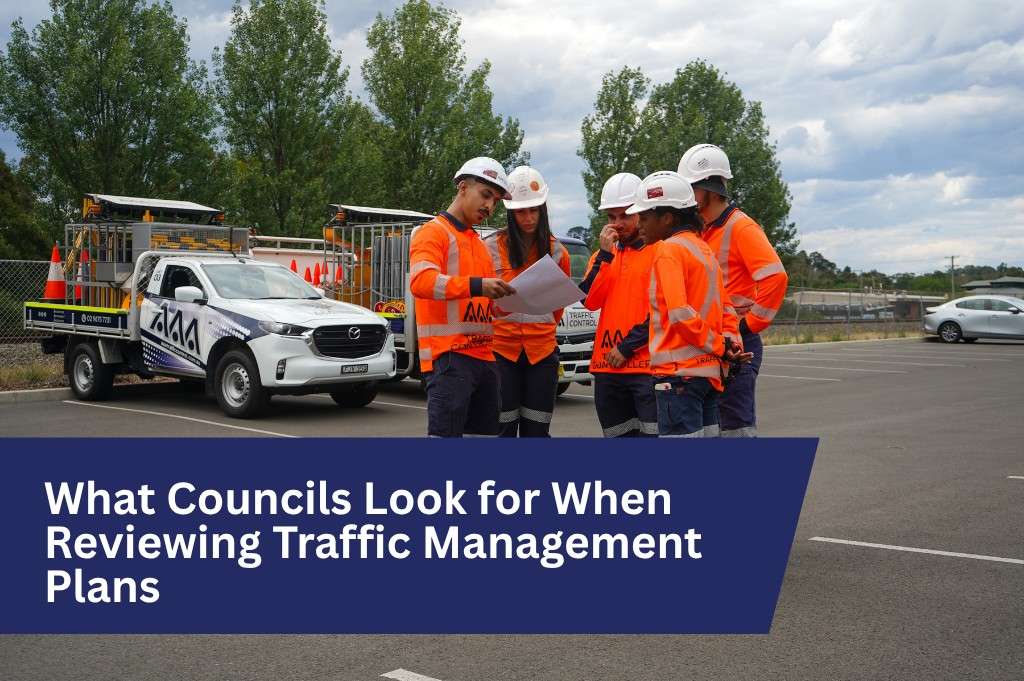
A Traffic Management Plan rarely gets rejected for the reason you’d expect. It’s not always the swept path diagram or the sign spacing. Councils work through a submission in layers, from what’s easiest to spot to what’s hardest to fake. Here’s that same order, covering rookie mistakes first.
1. Language That Gives You Away
Before an assessor checks a single measurement, they’re already reading your plan for tone.
Using ‘Traffic Control Plan’ tells them the author hasn’t kept up. TfNSW retired that term years ago in favour of the Traffic Guidance Scheme (TGS), and outdated language reads as a proxy for outdated compliance.
The same instinct applies to the diagram. A stock layout borrowed from a similar job, missing the power poles, utility pits, fire hydrants and driveway gradients actually on your site, is easy to catch against aerial imagery. Get this surface layer wrong, and everything beneath it gets read with more suspicion.
2. Who You Notified and When
Address surface checkboxes and the next question that comes up is “Who else uses this street?”
Under the Movement and Place framework, councils weigh pedestrian amenity, outdoor dining and shopfront access alongside vehicle movement. But this is where notification often gets forgotten.
A plan with no evidence of consultation reads as an afterthought, as councils increasingly knock back submissions that block footpaths or trading frontages during business hours (no matter how sound the engineering beneath it is).
3. Keeping Every Door Open
Notification covers who was told, access covers whether they can still function.
Councils check that driveways, loading docks and pedestrian entries stay usable for the life of the works, with clear provision for bin day and deliveries.
The assessors present there want a documented path width for fire and ambulance vehicles at every stage of your job. This is where your plan needs to demonstrate that every property along that stretch remains reachable, day and night, for as long as the works run.
4. Proving the Numbers Work
Everything so far can be checked by eye, but from here the review gets a bit mathematical.
A swept path diagram must demonstrate that the largest vehicle on site can enter and exit in a forward direction without blocking the live lane. AS 1742.3 governs the rest, including taper lengths, buffer zones and sign spacing, set against the posted speed limit.
However, the real tell isn’t the geometry, it’s the risk assessment behind it. Assessors spot a hazard list recycled across five unrelated projects in seconds. One that reflects the actual gradient, sightlines and nearby school zone is what separates an approval from a request for more information.
5. Whose Road You’re Actually On
The deepest question in the review has nothing to do with your plan’s quality, it’s about authority.
Roughly eighty percent of the NSW road network belongs to local councils, but works within 100 metres of traffic signals, or on a classified state road, hand approval to Transport for NSW under the TCAWS manual. A council permit, however well prepared, won’t release you to start.
⚠️ AAA Traffic Control Notes: A ROL lodged through the TfNSW system and assessed by the Transport Management Centre becomes mandatory here. It’s the costliest layer to miss since it can stop a project after the council has already said yes!
Get It Approved with Ease
At AAA Traffic Control, only our TfNSW G10 certified team builds Traffic Management Plans, Traffic Guidance Schemes and permit applications that clear every layer. To discuss your project, get in touch or call (02) 9675 7731.
FAQs
1. Why do local councils commonly reject Traffic Management Plans?
Rejections often come from outdated terminology, generic stock diagrams or incomplete stakeholder notification strategies.
2. How far in advance must a Traffic Management Plan be submitted to council?
Most local councils require submissions between ten business days to four weeks prior to starting works. Complex developments or road closures involving state roads may require up to six to eight weeks to allow for multi-agency assessment.
3. Who is responsible for notifying nearby residents and businesses about works?
You, as the applicant/developer, hold responsibility for stakeholder communication. It is important that your plans outline written notification strategies, including letterbox drops, VMS and advance notice timeframes.
4. What is a Road Occupancy Licence and when is it mandatory?
A ROL grants you formal permission to use or close a lane, shoulder, or footpath on a state road network. It is mandatory for any activity that affects traffic flow or road capacity on the roads managed by TfNSW.
5. Does a council approval allow works to begin if state road approvals are missing?
No. A council permit only applies to local road jurisdiction. Commencing work without a required Road Occupancy Licence from Transport for NSW is illegal and can lead to immediate site shutdowns and heavy fines.
6. How long does an approved Traffic Management Plan remain valid?
Validity depends on the council permit conditions and the scope of work. Most permits cover a specific date range or project phase. Any changes to site conditions, working hours, or traffic setups require a formal modification and reassessment.
Stay Updated with AAA Traffic Control
Make AAA Traffic Control a preferred source on Google for relevant traffic management insights, industry updates and useful information.