Every worksite carries a different level of traffic risk, and the right solution changes with it. Professional traffic control prevents delays, fines and safety incidents by aligning the right traffic management plan, permits and on-site crew to the actual risk levels involved, whether it’s a suburban footpath closure or a full motorway lane shutdown.
In this article, we discuss 5 scenarios where you might face worksite disruptions without professional traffic control services and their solutions.
1. Residential Driveway Works in Thornleigh
The scenario: A landscaping crew needs to pour a new concrete driveway on a quiet residential street in Thornleigh, on Sydney’s Upper North Shore. The job requires blocking half the street for six hours while the truck offloads and the concrete sets.
The challenge: Councils in this area expect a compliant, low-key setup, particularly on school-run streets.
The solution: A simple Traffic Guidance Scheme (TGS) covering signage placement, a single lane closure and a spotter is generally enough here. It’s lodged with the local council as part of a standard road occupancy permit, and one or two accredited traffic controllers manage pedestrian and vehicle movement for the short duration of the pour.
2. Retail Fit-Out Near a Busy Strip in Hornsby
The scenario: A shopfront renovation on a busy Hornsby retail strip requires a skip bin and scaffold to sit on the footpath for two weeks, narrowing the pedestrian path right outside a cafe and a pharmacy.
The challenge: Foot traffic is constant, and elderly pedestrians and prams use the strip daily. Also, the businesses simply can’t afford reduced visibility or blocked access.
The solution: This calls for a full Traffic Management Plan, including a pedestrian diversion route, hoarding signage and daily setup checks over the fortnight. Council permit applications need to account for retail trading hours, meaning work zones are often more heavily signed during the morning and lunch peaks than overnight.
3. Utility Trenching Across an Intersection in Castle Hill
The scenario: A water authority needs to trench across a signalised intersection in Castle Hill to connect new residential infra. It is requiring partial lane closures across two approaches for several days.
The challenge: Intersections carry higher risk because of merging traffic, turning vehicles and the potential to affect signal phasing. A poorly planned closure here can back up traffic well beyond the worksite and draw regulatory scrutiny.
The solution: This scale of work needs a properly engineered Traffic Guidance Scheme built around swept path modelling for larger vehicles and staged lane closures. It also requires coordination with TfNSW where signal timing is affected. The good news is that accredited traffic controllers manage each approach in real time.
4. Multi-Storey Construction Site on a Ryde Arterial Road
The scenario: A construction company is building a multi-storey residential development on an arterial road in Ryde. The site needs a permanent crane zone, constant deliveries and a temporary construction access point cut into the kerb. This all while maintaining two lanes of through traffic during business hours!
The challenge: You must know that arterial roads carry higher volumes and speeds. And this is where any reduction in lane capacity has a ripple effect on surrounding streets. Crane lifts also require intermittent full-lane or partial closures, each requiring individual approval and exclusion zones.
The solution: Projects of this scale requires a Construction Traffic Management Plan and TfNSW TMC Road Occupancy Licence approval. Seamless coordination between site management and the traffic control provider is essential, since crane lift days and concrete pours each require short-notice closures layered on top of the standing plan.
5. Night-Time Motorway Lane Closure for Bridge Maintenance
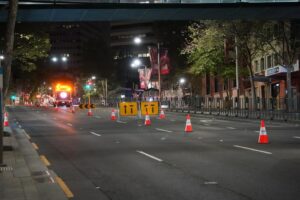
The scenario: Consider a civil contractor that needs to close two lanes of a Sydney motorway overnight for structural maintenance on an overpass. This, with full lane restoration required before the morning peak.
The challenge: This is the highest-risk category of worksite. High-speed traffic, low visibility, tight overnight time windows and zero tolerance for delays into peak hour all compound the difficulty.
The solution: Motorway-grade jobs require Truck Mounted Attenuators TMAs, advance warning vehicles, and a full emergency response traffic management contingency in case the works overrun or an incident occurs. This is where experience and 24/7 crew availability matter most.
Clearly, the 5 scenarios above show a pattern.
The pattern is that it’s not always the biggest job that carries the most risk. A short footpath closure near a school crossing can demand more careful planning than a longer job on a quiet cul-de-sac.
What matters is matching the traffic management planning to the actual conditions on the ground, rather than defaulting to a generic setup.
AAA Traffic Control Can Help
At AAA Traffic Control, these scenarios reflect our two decades of industry experience.
We address these challenges through every stage, from initial TfNSW TMC ROL approval to final lane reopening, by planning for and responding to rapid changes in real time.
We also use advanced traffic control equipment, including variable message signs and C’ Class arrow boards, to warn drivers well before they reach reduced lanes.
To get started, simply share your challenges with us at info@aaatc.com.au or (02) 9675 7731.
FAQs
1. What is a Truck Mounted Attenuator and when must it be used?
A Truck Mounted Attenuator is a heavy vehicle fitted with a crash-absorbing structural cushion at the rear. It protects workers from high-speed impacts and is mandatory for most night works on motorways or roads with speed limits exceeding eighty kilometres per hour.
2. How much does hiring a professional traffic control crew cost per hour?
Rates depend on the size of the crew, the day of the week, and whether the work takes place during the day or night. It is best to get the latest information at (02) 9675 7731.
3. How do variable message signs improve worksite safety?
We see them frequently on Sydney’s road network. Variable message signs (VMS) provide real-time visual warnings to drivers about upcoming lane changes. These include delays or speed reductions, allowing motorists ample time to react and slow down safely.
4. How does heavy rain affect traffic management permits?
If weather conditions halt a project, the contractor must notify the relevant authority to cancel or postpone the active permit. Work cannot simply resume on a later date without obtaining a revised or extended permit.