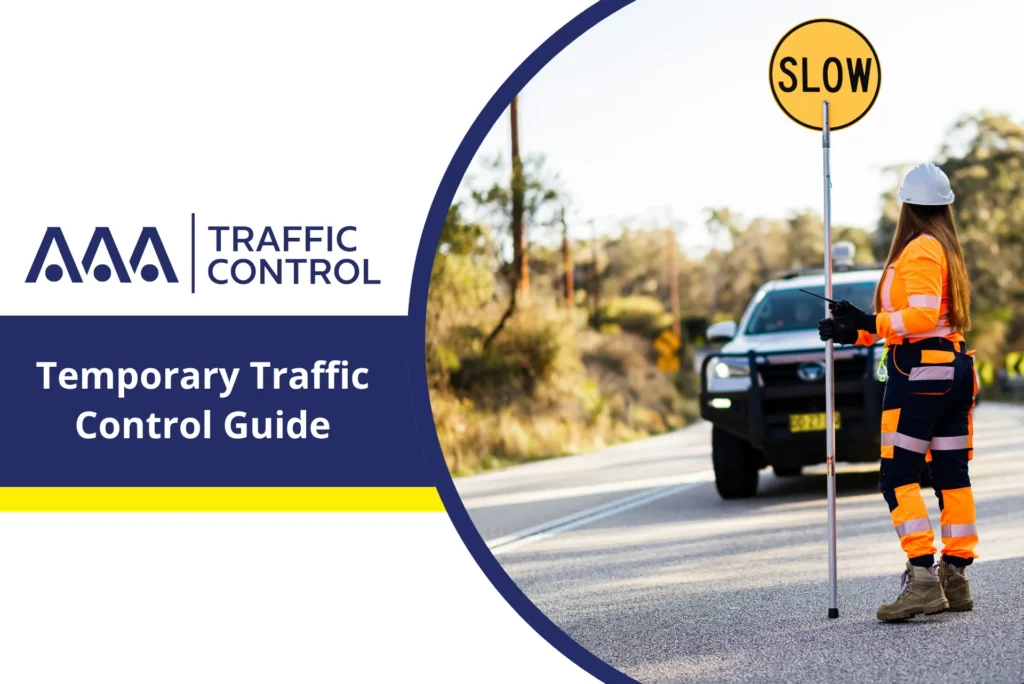
Any time work touches a public road, a footpath closure for a shopfit-out, a busy construction site or a two-day community event, someone has to work out how people and vehicles will move around it safely. That’s temporary traffic control.
In 2026, the rules around it have changed in ways that affect almost everyone who works on or near a road. So, join us as we understand the 10-part set around temporary traffic control in 2026.
What Is the AGTTM and Why Does It Matter?
Every cone, sign and traffic controller on a Sydney worksite is working from the same rulebook.
The Austroads Guide to Temporary Traffic Management, or AGTTM, is the national framework for planning, designing and running traffic control on and near roads across Australia and New Zealand.
It is published in ten parts, covering everything from planning principles through to sample worksite layouts. The most recent edition, 1.2, was released in May 2026.
What does AGTTM include?
Structurally, it breaks down by role and site type.
Parts 1 and 2 cover philosophy and planning, Parts 3 to 6 cover site design and field operations, Part 7 covers traffic controllers, Part 8 covers categories and training and Parts 9 and 10 provide sample layouts and supporting guidance.
For a project manager, this matters because every traffic management plan, traffic guidance scheme and traffic controller accreditation on your site is measured against it. It is also the document councils and Transport for NSW point to when something goes wrong.
Building the Plan: Risk, the Safe System and Approvals
Before a single sign goes up, someone has to build a traffic management plan (TMP).
This is where we see that part 2 of the guide sets out how a TMP identifies site risks, works through a hierarchy of control (eliminate, separate, or control the hazard) and documents how the site will be inspected and reviewed. It also covers who needs to sign off before work starts.
This whole process sits inside what is called the Safe System philosophy. It assumes road users, workers and drivers will occasionally make mistakes, so the worksite itself is designed to reduce the consequences. That is why for AAA Traffic Control experts, a good TMP looks less like paperwork and more like a safety net.
Designing the Site: Static Works, Mobile Works and Short Jobs
Not every job on a road looks the same, so the guide treats them differently.
- Part 3 covers static worksites, breaking the design into what happens around, through and past the site, including advance warning areas, safety buffers and termination points.
- Part 4 covers mobile works, such as line marking or mowing crews, where the whole site moves along the road.
- For smaller jobs like a footpath patch repair, we learn that Part 5 sets out dedicated short term & low impact provisions.
Together, these allow a lighter, faster setup that is still fully compliant.
🚧 AAA Traffic Control notes: Matching the right category to your job means you are not paying for more traffic control than the site needs and neither under-protecting it.
Know the Experts Behind the Signs: Planners and Controllers
A traffic guidance scheme is only as good as the person running it.
- Part 7 sets out exactly what is expected of a traffic controller. It includes accreditation, fitness for duty, correct high-visibility clothing and approved hand signals for STOP and SLOW control. Interestingly, it also covers how a control station should be set up and monitored throughout the day.
- Part 8 goes a step further, defining the TTM Categories and the National Training Framework that governs how traffic controllers, implementers and designers are trained and kept in sync with the latest developments.
This is also where experienced team leaders from AAA Traffic Control play a pivotal role. They make sure that the above prerequisites are maintained to the highest standards.
The Latest Developments
In June 2026, Transport for NSW replaced its old traffic control manual with a brand new standard (TS 05492:1.0). From 1 July 2026, following this new standard for speed limits in work zones became a legal requirement, not just best practice.
For anyone managing works near a road in Sydney, the AGTTM is less a document to memorise and more a quality benchmark. A plan built against it should hold up to council or Transport for NSW scrutiny, keep disruption to the public down and protect your crew on-site.
At AAA Traffic Control, our TfNSW G10 certified team designs every traffic guidance scheme against this exact framework. That means plans that are compliant from the first submission, not sent back for rework.
Our Closing Notes
Amir, our Managing Director at AAA Traffic Control, observes, “After years in this industry with AAA Traffic Control, what stands out to me about 2026 isn’t any single rule change, it’s the direction they all point in. NSW’s new standard, the Austroads update, WA’s training changes and us… All chase the same goal, viz. closing the gap between what looks safe on paper and the ground.”
He adds, “Technology helps, but it doesn’t replace judgement. A camera equipped with AI can indeed flag a stopped car, but it still takes a trained person to decide what happens next. And that part of the job hasn’t changed, and I don’t expect it to.”
So, if your current traffic plan needs a check against these changes, our experts at AAA Traffic Control can help. Because with us, plans are made to be compliant from the first submission.
FAQs
Q. Do I need a Traffic Guidance Scheme for minor trade or shopfront works on a footpath?
Footpath closures demand safe pedestrian diversions to protect the public from site hazards. And any work that impacts public footpaths, cycle lanes or road shoulders requires an approved Traffic Guidance Scheme.
Q. How do utility crews handle emergency road closures for sudden main breaks?
Accredited emergency response traffic control teams deploy rapid-response vehicles within tight timeframes to establish temporary safety zones, redirect traffic and notify transport management centres while emergency repairs take place.
Q. Do community events like street fairs require a full Traffic Management Plan?
Yes. Any public event that closes roads, alters bus routes or generates high pedestrian movement requires an event Traffic Management Plan, local council approval, police notification and coordinated traffic control teams.
Q. Can I manage traffic on a public road using my own site workers?
We don’t recommend doing so. Directing traffic on public roads requires accredited traffic controllers holding valid state qualifications, such as the SafeWork NSW Traffic Control Work Training card. Unaccredited personnel directing live traffic face immediate site shutdown and regulatory penalties.
Q. What happens if an unapproved traffic management setup causes a traffic delay?
Unapproved traffic control setups trigger immediate council or police intervention, resulting in site shutdown orders, heavy financial penalties and potential cancellation of development approvals or contractor pre-qualifications.