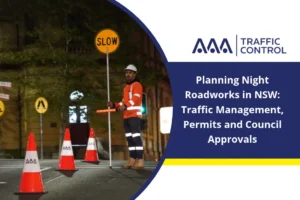
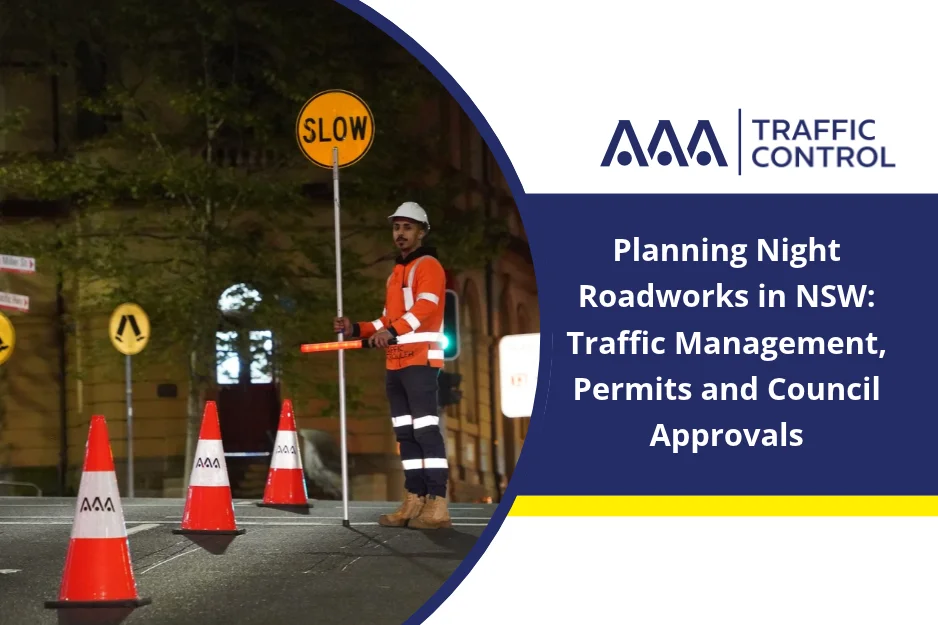
If you ask experienced traffic management companies in Sydney how to plan night roadworks in NSW, they’ll point to four key steps. These include preparing a traffic management plan, lodging the Transport for NSW Road Occupancy Licence and council permits, setting noise conditions, followed by booking accredited controllers.
Night works enable inspection and maintenance of services without causing inconvenience to Sydneysiders. But moving a job after dark impacts visibility, driver behaviour, noise limits and approval windows. If your approvals aren’t lined up for the hours you plan to work, here is how AAA Traffic Control experts give an overview of planning it.
1. Start With Your Plan, Not the Work Program
Every night job hangs off a traffic management plan (TMP). TfNSW will not consider your ROL application without a TMP and a Traffic Control Plan attached. The person who prepares them must hold a current Select / Modify Traffic Plans qualification or higher.
Night conditions change your approach and strategy dramatically. Quiet roads tend to see faster approach speeds, so it is important to revisit advance warning distances & tapers instead of copying the day scheme. Our AAA Traffic Control team writes to the TCAWS Technical Manual and AS 1742.3, with the Austroads Guide to Temporary Traffic Management as our wider reference.
We prepare your traffic management plan, the traffic guidance schemes (TGS) beneath it and construction TMPs for larger projects, all written for the hours you will actually work. Because we also supply the crews, the scheme on paper is the one we set out on the road.
2. Know Which Approvals Sit With Whom
An ROL covers only road space, it does not approve the physical works. Notably, restricted periods generally apply around school and public holidays. Councils run their own process for council roads and public land, so one job can need several sign-offs at once. Lodging a traffic control permit late is a quick way to lose a night shift.
| Approval | Issued by | Typically covers |
| Road Occupancy Licence (ROL) | TfNSW / Transport Management Centre (TMC), where applicable | Occupying or affecting road space on roads managed by TfNSW |
| Section 138 approval / work zone approval | Local council or relevant road authority | Works within a public road reserve, including footpaths and work zones, where applicable |
| Out-of-hours work approval | Council or relevant consent authority | Construction or other work proposed outside permitted standard hours |
| Police approval or traffic support | NSW Police, where required | Traffic control, major closures or activities requiring police involvement |
| Bus operator approval | Relevant bus operator / transport authority | Works that affect bus routes, stops or bus operations |
How early should you lodge? Lead times might run from a day to three months depending on the permit and the council, so the approvals workload belongs at the front of your program. Our permit application team prepares and lodges every traffic control permit you need, from ROL applications and council permits to police and bus approvals, then follows each one through to sign-off. We deal with councils and the TMC regularly, so a query usually gets a quick answer instead of a resubmission.
3. Noise Usually Decides Night Works
The EPA’s Interim Construction Noise Guideline recommends standard construction hours of 7 am-6 pm on weekdays and 8 am-1 pm on Saturdays. This includes no work on Sundays or public holidays, unless anything outside those hours is justified and supported by a noise management approach the approving authority accepts.
Interestingly, councils also commonly attach notification conditions, so it’s important to plan letterbox drops to affected residents and businesses before the first shift begins. Saw cutting, breaking and compaction draw the most complaints, so sequence them early in the shift or separate them from quieter tasks.
We urge you to discuss these with your traffic management consultant.
4. Setting Up the Site After Dark
Lighting is your first equipment decision. Light towers, also called Daymakers, give the work area reliable illumination. Their adjustable height and direction matter, because glare thrown at oncoming drivers or nearby bedrooms creates a problem of its own. Arrow boards, variable message signs and water-filled or concrete barriers define the closure so drivers read it early.
Night shifts need accredited controllers, and where speeds are high, a truck-mounted attenuator (TMA) operator adds a layer of protection for the crew. Our traffic control Sydney crews are accredited TfNSW traffic controllers, including team leaders and TMA operators, briefed on your TGS before each shift.
At AAA Traffic Control, we boast the equipment listed above, with delivery, setup and collection, from a fleet of more than 35 specialised vehicles.
Need a Traffic Management Plan?
AAA Traffic Control can help →5. Plan for the Night That Goes Sideways
What happens if a shift overruns, or a crash closes the adjoining lane? Approved ROL shifts are activated and deactivated through the TfNSW MyROL portal, so an overrun needs a conversation with the TMC, not an assumption. A failed lighting rig or an incident at 2 am needs a response at 2 am.
That is why we run emergency response traffic management around the clock, sending accredited controllers and compliant equipment to accidents, hazards and unexpected closures.
AAA Traffic Control Helps Night Works Approved With Ease
We are TfNSW G10 certified, with more than 20 years on NSW roads, and we deliver traffic management Sydney-wide and across the state. Whether you have one lane closure or a multi-week program, we have the capabilities to handle the traffic management Sydney projects need, and our traffic control Sydney crews stay through inception to final delivery.
If you have night-shift work to schedule around NSW’s arteries, call AAA Traffic Control experts on (02) 9675 7731 or request a quote, and we will talk through the plan, the permits and the crew with you.
FAQs
Q. What happens if you work on a road without a permit?
You risk being told to stop work on the spot, plus penalties under roads legislation, and you carry the liability if an incident happens. Your insurer may also take a dim view of unapproved works. It is far cheaper to lodge the application than to deal with a stopped shift and a crew standing idle.
Q. Do I need a permit for a crane, skip bin or hoist on the road at night?
Usually, yes. Placing a mobile crane, a skip bin, scaffolding, a hoarding or a pump on a road or footpath normally needs a council permit, and often a traffic control plan to go with it. Councils name these permits differently, so check the exact wording on your local council’s website.
Q. How are workers kept visible and safe at night around the roads?
We may use a combination of high visibility clothing with retroreflective tape rated exclusively for nighttime use, proper lighting, clear advance signage and physical barriers between crew and traffic. We run pre-start briefings and manage fatigue as much as the equipment, since tired workers and tired drivers are a real risk on night shifts.
Q. Can I get traffic control at short notice or overnight in Sydney?
Yes. We run a 24/7 emergency response service and can send accredited controllers and equipment to crashes, road hazards and urgent repairs. Planned night works still need approvals, so we suggest booking early, but if you need help now, call us on (02) 9675 7731.