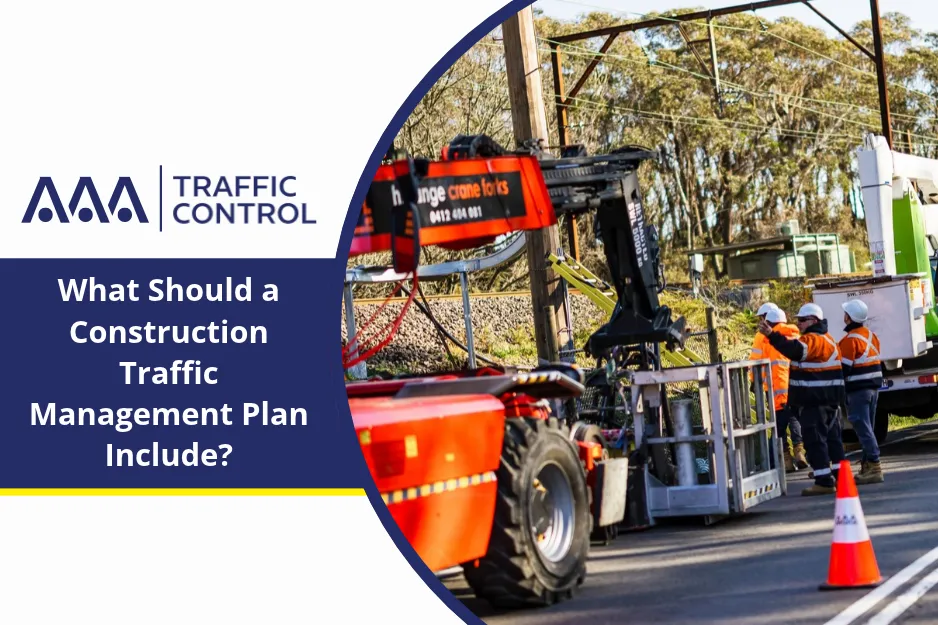
A construction traffic management plan should cover many aspects that need to work in sync. It includes site conditions, truck routes, a vehicle movement plan, traffic guidance schemes, pedestrian access, work hours, approvals and a monitoring process, all matched to the specific site.
In our experience, plans are rarely returned for poor writing. They come back because a required element is missing, or because the document does not match how the site will really run. A systematic construction traffic management plan helps you avoid all of that. To help you understand how and what it should ideally include, read on.
A Construction Traffic Management Plan at a Glance
Use this table by AAA Traffic Control to check each construction site traffic management plan before submission.
| Aspect | What it Shows |
| Site context | Road hierarchy, speed limits, schools, bus stops |
| Vehicle routes | Approved truck routes and roads to avoid |
| Vehicle movement plan | Swept paths, turning areas, on-site queuing |
| Traffic guidance schemes | One scheme per activity, designed to AS 1742.3 |
| Pedestrians and cyclists | Detours, ramps, crossing controls |
| Hours and staging | Consent hours, movements per stage |
| Approvals and personnel | Roads Act consent, Transport for NSW approval, SafeWork NSW cards |
1. Site Context and Existing Conditions
Start with the road network as it stands today. It is important that you describe the street hierarchy, speed limits, load-limited or narrow roads, nearby schools, bus stops, signalised intersections and peak traffic periods.
This is because reviewers want proof that the author has walked the site. And a construction traffic management plan Sydney councils will approve should also name neighbouring projects, because overlapping truck movements draw objections.
2. Vehicle Routes, Access Points and the Vehicle Movement Plan
The vehicle movement plan is the drawing that proves your route works. Transport for NSW describes it as a plan showing how works-related traffic, including visitors, will safely enter, move around and leave a work site.
List the approved truck routes in and out, and the roads vehicles must avoid. North Sydney Council, for example, expects an approved truck route plan to be issued to every driver, and requires vehicles to enter and exit in a forward direction unless it approves a one-off exception.
Additionally, include swept path diagrams for your largest vehicle, turning areas, on-site queuing space and the expected number of movements at each stage. If you need one drawn up, our vehicle movement plan service covers exactly this.
3. Traffic Guidance Schemes and Control Measures
Any activity that changes how traffic moves, such as a crane pick, a lane closure or a footpath diversion, needs its own traffic guidance scheme (TGS).
A TGS was previously called a traffic control plan. You must attach each one as an appendix and tie it to the stage it supports. If you are unsure which activities trigger one, our guide on when a project needs a traffic guidance scheme explains it.
Technically, design must follow AS 1742.3 and the TCAWS Technical Manual. However, that manual is mandatory for Transport for NSW work only. Other road authorities set their own temporary traffic management requirements.
Need quick answers? Call us at (02) 9675 7731 to get help on confirming who controls the road.
4. Pedestrians, Cyclists and Public Transport
Perhaps the most important aspect that can make or break your approval chances.
It is your responsibility to show how footpath access is maintained, where detours run, how ramps are provided and how crossings used by heavy vehicles are controlled. Also, emergency vehicle access and bus stops must be given due consideration here.
North Sydney Council’s standard conditions, for instance, require Transport for NSW approval before any temporary change to a bus stop or traffic signals.
5. Hours, Staging and Delivery Scheduling
Next, you must state the approved work hours, then break the build into stages such as demolition, excavation, structure and fit-out.
For each stage, give vehicle types and estimated daily movements. It is important you schedule concrete pours and oversize deliveries away from peak periods and school pick-up times.
If you ask us, this is the section that makes your traffic management plan for construction sites credible, because it shows the numbers behind the promises.
6. Monitoring, Incident Response and Review
A plan that is filed and forgotten will not protect anyone.
To avoid this, set out how often the site is inspected, who records changes, how complaints are handled and how incidents are reported. Some development consents also ask for an adaptive response plan that explains how you will react if traffic conditions shift mid-build.
Many councils treat an approved plan as fixed, so it is imperative that you build in a clear variation process. For the wider process, read our overview of when a construction traffic management plan is required in NSW.
Need a Traffic Management Plan?
AAA Traffic Control can help →How We Support Your Plan, From Approval to Site
At AAA Traffic Control, a TfNSW G10 certified team supports you at every stage of efficient and safe traffic management for your site.
We offer comprehensive services like:
- Construction traffic management plans: site-specific documents written around your council’s consent conditions.
- Vehicle movement plans and swept path assessments: drawn against your largest vehicle and your actual gate.
- Traffic guidance schemes: designed to AS 1742.3 for closures, crane picks and detours.
- Permit applications: council permits and Transport for NSW road occupancy licence approvals, handled for you.
- Accredited traffic controllers and equipment hire: qualified people, signs and barriers on site.
- Emergency response: 24/7 support when conditions change.
So, when you are ready to start, get in touch with AAA Traffic Control because only with us, you get an unmatched experience at an unbeatable price for all your traffic management needs across Sydney.
FAQs
1. What is a construction traffic management plan?
It is a site-specific document explaining how vehicles, pedestrians and cyclists will move around a construction site and the surrounding road network during the build. It typically covers truck routes, access points, work hours, pedestrian safety and the control measures used on public roads.
2. Is a construction traffic management plan the same as a traffic management plan?
Not exactly, as the terms overlap. A construction traffic management plan is tied to a building or civil project and usually responds to a development consent. A general traffic management plan can also cover events or roadworks with no development application.
3. When is a construction traffic management plan required in NSW?
Most often it is a condition of development consent, particularly for demolition, excavation and larger builds. It can also be triggered by cranes, hoardings, road or footpath occupation and heavy vehicle activity (even where no development application applies).
4. Can a construction traffic management plan be changed after approval?
Many councils treat an approved plan as fixed, so changes to routes, staging, or work hours may require a new assessment. At AAA Traffic Control, we suggest checking your consent conditions & speaking to the council before altering anything on site.
5. What is the difference between a traffic management plan and a traffic guidance scheme?
A traffic management plan sets the overall approach, risks and controls for a project. A traffic guidance scheme is the technical layout showing where signs, cones, barriers and controllers sit for one activity at one location. Schemes were previously called traffic control plans.
Stay Updated with AAA Traffic Control
Make AAA Traffic Control a preferred source on Google for relevant traffic management insights, industry updates and useful information.