Every project that involves a public road carries a fundamental responsibility to protect everyone involved, from workers on the ground to motorists and pedestrians passing by. At the heart of this safety commitment is a well-prepared Traffic Guidance Scheme. Regardless of scope, the rigour applied to Traffic Guidance Schemes (TGS) is a direct determinant of how safe a site is.
That is why this week, AAA Traffic Control consultants discuss the top 5 reasons highlighting the need for Traffic Guidance Schemes (TGS) for your project’s safety.
Understanding What Traffic Guidance Schemes (TGS) Are
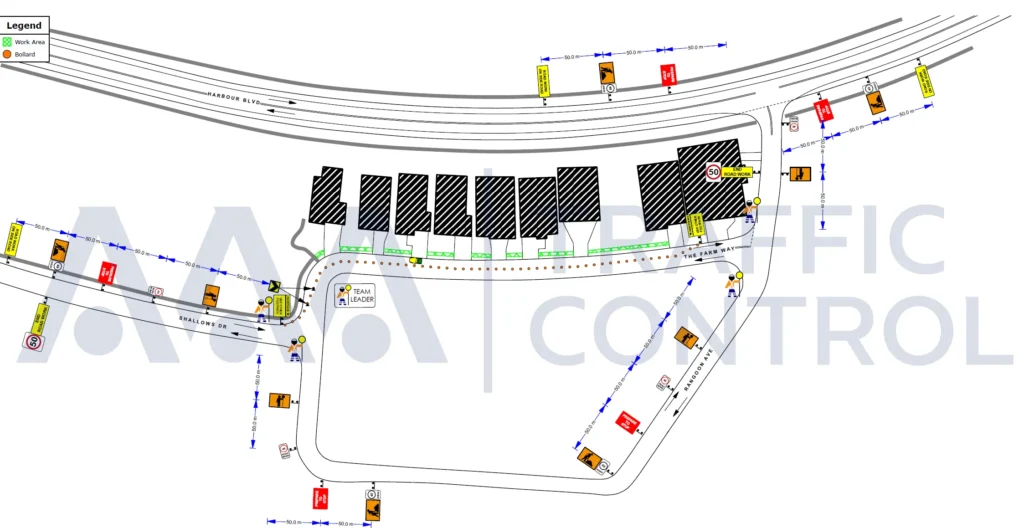
A TGS is far more than a simple diagram for a road authority.
- It is a site-specific document detailing how every road user will move around an active site.
- It outlines the exact placement of signs, taper lengths, temporary speed limits, and the specific duties of traffic controllers.
- It confirms where heavy machinery operates and how an approaching driver will see the worksite from a distance.
Clearly, a TGS stands as an essential component of any infrastructure project.
Now, let’s learn how they help you in…
- Reducing Risk on the Road
With years’ worth of experience, we have witnessed how most serious incidents, live traffic meets active construction. Traffic Guidance Schemes (TGS) are designed specifically to manage this interface.
When a plan adheres to AS 1742.3 and reflects real-time site conditions, it creates a vital buffer between the crew and moving vehicles. Without a compliant scheme, this protection disappears.
- Establishing Clear Communication for Commuters
While site workers attend briefings and wear safety gear, the general public has no such preparation. They are often unaware of the hazards ahead.
- Traffic Guidance Schemes (TGS) act as the primary communication tool for these road users.
Through clear signage and physical barriers, the project explains the risks and directs people safely through the work zone.
- Fulfilling Compliance as a Safety Essential
Across Australia, having an approved TGS is a legal requirement for roadworks. However, compliance should be seen as the minimum starting point.
- Traffic Guidance Schemes (TGS) are valuable because they work operationally, reducing measurable risk.
Here, it is important to understand that approving a scheme just to tick a box overlooks the power it has as a genuine safety tool.
- Maintaining Consistency Across Every Shift
A worksite relies on more than the knowledge of one supervisor. Crews change, and conditions vary between day and night.
Well-designed Traffic Guidance Schemes (TGS) ensure that all controllers follow the same plan. Consistent sign placement and exclusion zones prevent individual interpretation, which is often where safety errors begin.
- Adapting to Changing Site Conditions
One of the most significant and preventable failures in traffic management is not the absence of a scheme, but the continued use of an outdated one.
A Traffic Guidance Scheme that reflects last month’s site layout is not a valid operational document for today’s works.
At AAA Traffic Control, scheme review is an integrated component of ongoing project management, not an administrative afterthought. The scheme in use must, at all times, accurately represent the site as it currently exists.
The Safety Imperative One Cannot Overlook
The majority of serious worksite incidents involving the public occur at the interface between live traffic and active construction or maintenance works.
That interface is precisely what Traffic Guidance Schemes (TGS) are engineered to control.
When a scheme reflects genuine site conditions and receives appropriate approval prior to commencement, it establishes a physical and procedural buffer between moving traffic and site personnel.
A Partner That Understands the Responsibility
AAA Traffic Control team brings tested expertise to every scheme prepared and every site we undertake. Our traffic controllers are trained to current standards and operate with a clear understanding that a TGS is the operational plan they execute each shift.
We always look forward to fulfilling our responsibility to your project team, to regulators, and to the members of the public who share the road corridor with your site every day.
To learn more about how we can do this for your project, contact us at (02) 9675 7731.
FAQs
Q. What is the standard timeframe for a local council to review a permit application?
Depending on the complexity of the road network, local authorities typically require ten to twenty business days for a full review.
Q. What happens if a project team operates without an approved permit on a public road?
Authorities can issue immediate fines and stop-work orders, which often result in significant project delays and legal liability.
Q. Are there specific rules for conducting work on roads during night hours?
Night operations require high visibility lighting and reflective devices to compensate for low light and ensure the safety of the crew.
Q. What are the insurance implications of using an outdated site plan?
Using an expired or incorrect document can result in the denial of insurance claims if an incident occurs on the site.
Q. How are bus stops managed when they fall within a construction zone?
Stops are usually relocated to a temporary position in consultation with the local transit authority to maintain service for commuters.
Q. What defines the safety buffer zone in a technical road layout?
A buffer zone is a dedicated empty space between the traffic cones and the workers to provide a margin for error if a vehicle enters the site.
Stay Updated with AAA Traffic Control
Make AAA Traffic Control a preferred source on Google for relevant traffic management insights, industry updates and useful information.