Traffic management planning offers strategic blueprints for road safety during construction. Through a dedicated planner, Traffic Guidance Schemes ensure vehicle and pedestrian flow remains uninterrupted and regulatory compliance is maintained. Let’s understand why these and other factors matter in Sydney’s infrastructure projects in 2026.
It Begins with Strategic Planning and CTMP Development
In the context of major works, a planner develops a Construction Traffic Management Plan or CTMP. This comprehensive document serves as the master strategy for the site. It identifies how heavy machinery, delivery vehicles, and local traffic will coexist without causing gridlock.
A professional traffic management planning team evaluates:
- Peak traffic periods and vehicle volume data.
- The impact on public transport routes and bus stops.
- Specific requirements for emergency vehicle access.
- Pedestrian and cyclist safety pathways.
Then Comes the Implementation of Traffic Guidance Schemes
While a plan outlines the broad strategy, a Traffic Guidance Scheme (TGS) provides the detailed map for on-site execution.
- Planners use advanced software to design these diagrams, ensuring that every sign, cone, and barrier is placed in accordance with TCAWS standards.
- This meticulous detail is what prevents accidents at high-speed lane merges or complex intersections.
It ensures that every taper length and sign spacing provides drivers with enough reaction time to navigate changes safely.
You Are Further Covered Through Risk Mitigation and Safety Compliance
Safety is the primary objective of every project. A traffic management planner conducts thorough risk assessments to identify potential hazards before they become incidents. This includes:
- Site Isolation involves creating physical barriers between the workforce and moving traffic.
- Vulnerable Road User Protection includes implementing specific protocols for schools, hospitals, and high-footfall areas.
- Environmental Integration ensures that traffic measures do not negatively impact the local ecology and adheres to ISO 14001 standards.
We Coordinate For Road Occupancy Licences
Infrastructure projects often require the temporary closure of lanes or entire roads.
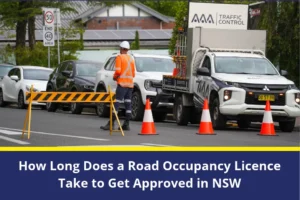
- An experienced traffic management planner oversees the complex process of obtaining a Road Occupancy Licence (ROL).
- We act as a liaison between the construction firm and authorities such as Transport for NSW and local councils.
This ensures that all legal permits are in place, preventing costly delays and non-compliance fines.
24/7 Coverage Through Specialised Night Operations
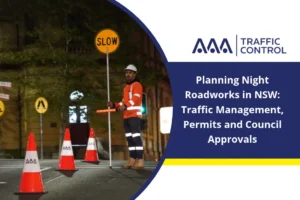
Most significant infrastructure projects require work to be carried out after dark to avoid major daytime congestion.
We understand that night work introduces unique variables, such as reduced visibility and increased risk of driver fatigue. A planner must meticulously design the lighting layout for these sites.
You Must Realise the Power of Predictive Modelling in 2026
Modern traffic management planning is no longer just about static maps.
Traffic management planning teams now use advanced digital simulations to predict how a proposed lane closure will impact the wider road network.
- By inputting data such as hourly vehicle counts and local speed limits, they can identify potential bottlenecks before they occur.
- When you see a detour that flows perfectly even during peak periods, it is usually the result of this high level digital testing.
This proactive approach allows for adjusting signal timings or widening temporary lanes to keep commuters moving without frustration.
Core Planning Aspects Summarised
Before we conclude, let’s quickly glance at what we have discussed this week.
| Project Aspect | How They Help |
| Technical Layouts | Detailed traffic control layouts give motorists, cyclists, and pedestrians clear visual guidance when normal road conditions are altered, helping reduce confusion and improve overall site safety. |
| Hazard Assessment | Early identification of site-specific risks allows contractors to implement appropriate control measures that protect workers, nearby residents, and all road users throughout the project duration. |
| Permit Management | Coordinating approvals with relevant transport authorities ensures the project complies with legislative requirements, traffic regulations, and operational conditions before works commence. |
| Traffic Simulations | Digital traffic modelling helps engineers evaluate vehicle movement patterns in advance, allowing adjustments that minimise congestion, reduce delays, and improve network efficiency during construction. |
| Site Coordination | Careful management of construction vehicle entry and exit points lowers the risk of interaction between heavy machinery, public transport services, and everyday traffic movements. |
Why AAA Traffic Control is Trusted To Protect Infra Projects in NSW
When you partner with a professional traffic management planner, you gain the benefit of years of field experience and technical knowledge.
What makes us apart at AAA Traffic Control is that we have spent over two decades refining our processes to support the most demanding infrastructure projects in the country.
With 12,000+ projects completed and accredited planners across Greater Sydney and beyond, we know what large infrastructure requires and how to deliver it.
Request a Quote or call us directly at (02) 9675 7731.
FAQs
Q. What qualifications does a traffic management planner need in NSW?
In NSW, a planner preparing Traffic Guidance Schemes must hold accreditation under the TfNSW framework. For larger or more complex projects, planners are typically accredited to prepare TMPs and hold additional qualifications in traffic engineering or civil design.
Q. How far in advance should traffic management planning start on a large infrastructure project?
For projects requiring ROL applications and council permits, a minimum of four to six weeks is realistic. Projects involving TfNSW state road approvals, classified intersections, or STA bus route impacts may require significantly longer lead times — particularly if community consultation is required.
Q. Can the same TGS be used across multiple stages of a project?
Generally, no. At AAA Traffic Control, we suggest that plans be revised and, in many cases, re-approved at each significant stage. This is because each construction phase introduces different site conditions, hazard locations, and traffic exposure. A TGS valid for bulk earthworks will typically not satisfy TCAWS requirements once the site configuration changes.
Q. What happens if works overrun a Road Occupancy Licence window?
Overstaying a TfNSW ROL window on a state road can attract immediate fines and may result in the project’s approval being reviewed. In high-volume corridors, the financial and reputational consequences escalate quickly. Your traffic management planning consultant should have a contingency procedure built into every night shift for exactly this scenario.
Q. Do we need a separate traffic management planner if we already have a civil engineer on the project?
Yes. Civil engineers design the infrastructure whereas a traffic management planner designs the safe working environment around it. These are distinct, accredited disciplines in NSW. Having both on your project team isn’t duplication, it’s the standard for any project working on or adjacent to a public road.
Stay Updated with AAA Traffic Control
Make AAA Traffic Control a preferred source on Google for relevant traffic management insights, industry updates and useful information.