Councils in NSW now assess a traffic plan for the latest TfNSW certifications, signage compliance, peak-hour timing conflicts, pedestrian safety, swept-path heavy vehicle analysis, upstream queuing, and proximity to state roads. So, is your plan ready for it? Can it ensure your projects are delivered on time and safely?
Join us in this week’s article, where we look at what happens behind the scenes in NSW traffic management.
1. Certification and Insurance Coverage
The initial stage of any assessment involves a thorough review of administrative documentation and legal prerequisites. Assessors verifying your Traffic Management Plan NSW look for current accreditation from Transport for NSW alongside comprehensive public liability insurance details.
These foundational checks include:
- Proof of formal qualifications for the individuals responsible for TGS preparation.
- Minimum insurance coverage limits that consider the scale of the road occupation.
- Alignment with the Work Health and Safety Regulation 2017 to protect all on-site personnel.
Without these critical documents, the local council can halt the application immediately to prevent unapproved road occupations. And once the administrative foundations are verified, the local authority shifts focus to the physical safety measures proposed on the ground.
2. Compliance with Australian Standards for Signage
Every local council requires absolute compliance with the physical layout rules set out in Australian Standard AS 1742.3.
This includes evaluating the precise placement of cones, barriers, and advance warning signs for:
- Taper lengths and buffer zones accurately match the posted speed limits of the area:
- Exact distances between advance warning signs and the actual work zone.
- Proper utilisation of speed limit signs specific to New South Wales dimensions.
Here, note that any deviation from the exact sign dimensions or mandatory placement rules will result in immediate rejection! That is why authorities frequently consult official technical manuals to also verify that proposed signs are lawful and proportionate to the environment.
3. Timing and Peak-Hour Conflicts
Organising traffic control services in Sydney requires strict adherence to holiday and peak-period embargoes. And this is where submitting accurate timelines helps authorities predict network strain and enforce necessary curfews to mitigate severe congestion as well.
It can be done through:
- Identification of high-volume commuter windows that prohibit any lane closures.
- Alignment with the updated holiday schedules to avoid state-enforced embargoes.
- Coordination with local school drop-off times and scheduled community festivals.
But while following these, you must know that the exact schedule of your proposed road disruption plays a vital role in the evaluation process.
How AAA Traffic Control helps: Our traffic management consultants analyse operational hours to prevent clashes with school zone periods, commuter peaks, or major regional events.
4. Protection of Vulnerable Road Users
Beyond managing vehicular congestion, pedestrian and cyclist safety requires a dedicated planning layer. Today, guidelines also emphasise the need for a robust Pedestrian Management Plan to separate heavy machinery from foot traffic.
It can ask you to consider:
- Provision of secure walkways with min widths between 1.2 and 1.5 mtrs
- Implementation of rigid physical separation barriers in high-density urban zones.
- Clear integration of temporary pedestrian crossing facilities that meet council standards.
AAA Traffic Control Notes: Forcing pedestrians onto live road shoulders is strictly prohibited and will result in immediate plan failure! Discussing and integrating the above safeguards into your overall Traffic Plan requires mapping out desired lines where people naturally walk.
5. Swept Path Analysis for Heavy Vehicles
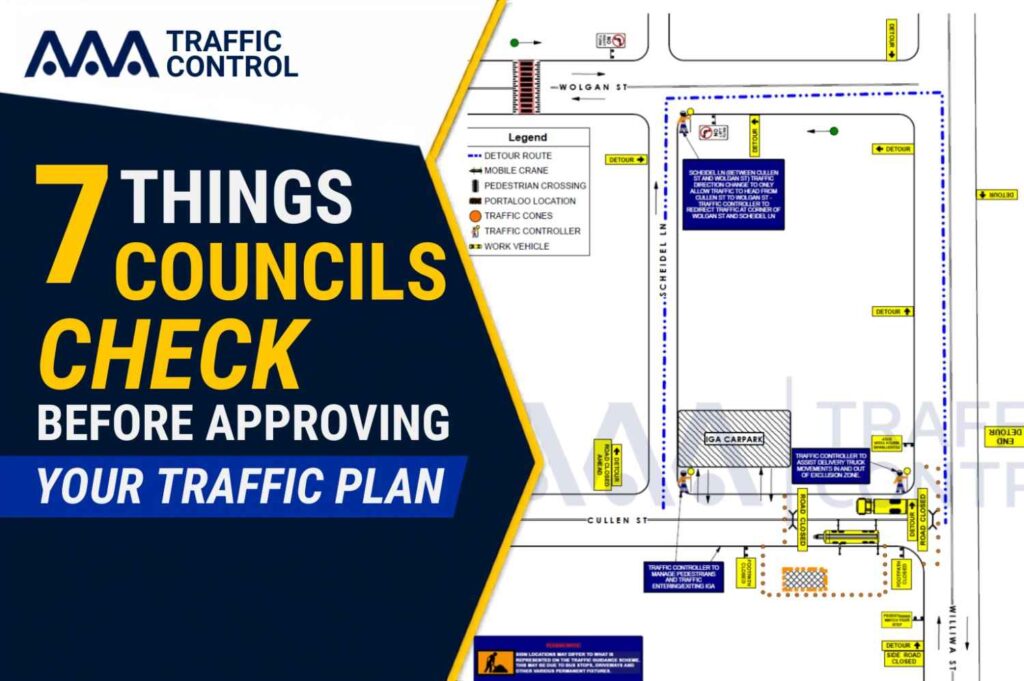
Assessing the movement capabilities of large construction vehicles is an inherently complex phase of the municipal evaluation. If your project involves massive trucks entering tight urban streets, a comprehensive swept path analysis diagram is a must.
- A high-quality site layout uses these geometric analyses to design safe exclusion zones and dedicated entry gates.
- Authorities scrutinise these movements to prevent dangerous multiple-point turns that block active traffic lanes.
- It helps verify forward entry and exit capabilities for all heavy vehicle deliveries.
Unsurprisingly, this technical drawing mathematically proves that the largest expected vehicle can safely enter and exit the site in a forward direction.
6. Upstream Queue Management
Evaluating the ripple effect of a work zone is a highly technical aspect of securing council approval for traffic control. Traffic management consultants calculate precisely how far vehicles will back up during a temporary lane closure or stop-slow operation.
We develop a queue management strategy to ensure waiting vehicles do not create secondary hazards or block critical intersections upstream through:
- Detailed calculations of expected queue lengths based on current traffic volume data.
- Strategic placement of advance warning controllers.
- Design of alternative detour paths to relieve pressure on the primary work zone.
However, even with perfect queue management, applicants must navigate complex legal boundaries that often surprise many.
7. The 100-Metre Rule and Jurisdictional Overlap
The most unexpected and complicated hurdle in the approval process involves invisible administrative boundaries.
- If your detour routes fall within 100 metres of traffic lights or impact a classified State Road, the council loses sole authority.
- In these overlapping scenarios, you must secure a formal Road Occupancy Licence directly from the Transport Management Centre before the council can proceed.
- Recent changes to our state online portal system require strict multi-factor authentication for all users submitting these applications.
So, how to address this final challenge?
Through measurement of proximity to state-managed traffic signals and major arterial highways, preparation and submission of licence applications via the state portal, and coordination between municipal bodies and the state Transport Management Centre.
We Can Make It All Easy For You
Navigating the complexities of local council approvals and state regulations need not stall your project.
At AAA Traffic Control, we handle the entire traffic planning process from inception through delivery. We bring over two decades of expertise to ensure your site layout is safe, fully compliant, and approved without unnecessary administrative delays.
So, whether you need a meticulously designed Traffic Plan, a comprehensive swept path analysis, or assistance securing a formal ROL, our team of Transport for NSW-accredited professionals is ready to step in. Contact us today at (02) 9675 7731 or let us know about your next project here!
FAQs
Q. What is the difference between a Traffic Guidance Scheme and a Traffic Management Plan?
A Traffic Guidance Scheme is a physical diagram showing specific sign layouts. A Traffic Management Plan is a strategic document covering broader project impacts, detours, and stakeholder consultations.
Q. How long does a local council take to approve a standard road occupancy permit in Sydney?
Standard council permits usually take seven to fifteen business days to process. Complex applications or full road closures can extend this assessment period to six or eight weeks.
Q. What are the typical council lodgement fees for a Construction Traffic Management Plan application?
Initial assessment fees generally range from $ 200 to $1,200. Municipalities may also charge ongoing daily road rental fees depending on the exact footprint of your work zone.
Q. Who is legally qualified to design and sign off on a Traffic Plan for an NSW council submission?
Only professionals holding a valid Prepare Work Zone Traffic Management Plan accreditation can design and sign off. AAA Traffic Control ensures all layouts meet this strict requirement.
Q. When is a Transport for NSW Road Occupancy Licence required instead of a council permit?
You need a state licence when your activities directly impact classified State Roads, traffic signals, or major transit corridors. This must be secured before the council issues local permits.
Stay Updated with AAA Traffic Control
Make AAA Traffic Control a preferred source on Google for relevant traffic management insights, industry updates and useful information.