Australian Standards are essential for traffic control planning because they provide consistency, defensibility and safety across every stage of a project. Simply, when traffic control planning is done well, nobody notices. When it is done poorly, the consequences are immediate and costly. And this latter is the result of traffic management standards. This blog will highlight a few standards here and explain how they set clarity to help us all.
What are traffic control standards and why do they matter?
If you are not from the traffic industry, Australian traffic standards can sound technical or even intimidating. But at their core, they exist for one simple reason, i.e., to keep people safe, and traffic reaches its destination in a predictable and safe way.
Below is a quick explanation of the key standards followed in Australia, what they do in real life and what would likely happen if they did not exist.
1. AS 1742 is Your Manual of Uniform Traffic Control Devices
This is the backbone of traffic control in Australia. AS 1742 governs how road signs, line markings, cones and temporary signs should look, where they should be placed and how far apart they must be.
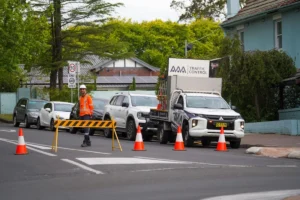
Why is it important? When you see the familiar ‘Roadworks Ahead’ sign followed by cones tapering smoothly into one lane, that layout is not random. AS 1742 specifies the sign size, colour contrast, distance from the work zone and cone spacing so drivers have enough time to react.
⛔What happens in its absence? Every work site would look different. Drivers would hesitate, brake suddenly or miss warnings altogether, increasing the risk of rear-end crashes and worker injuries.
2. Austroads Guide to Temporary Traffic Management (AGTTM)
The AGTTM explains how traffic should be managed when normal road conditions change, such as during construction, maintenance or utility works. It sets out traffic control categories, risk levels and responsibilities.
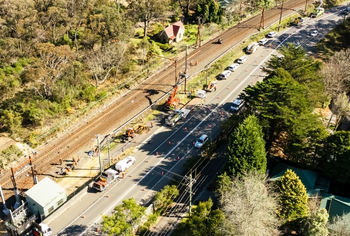
Whyis it important? If a road is partially closed for resurfacing, AGTTM helps determine whether traffic controllers, portable traffic signals or a detour is safest based on speed, volume and visibility.
⛔What happens in its absence? Decisions would be based on guesswork or cost alone, leading to unsafe shortcuts and inconsistent control methods from site to site.
3. Traffic Guidance Scheme (TGS)
A Traffic Guidance Scheme is a site-specific plan that shows exactly how traffic will move through or around a work zone. It is developed using AS 1742 and AGTTM principles.
Why is it important?Before works begin, a TGS map shows where signs, barriers, cones and controllers will be placed. This allows councils and road authorities to review and approve the setup before anyone steps on site.
⛔What happens in its absence? Traffic control would be reactive instead of planned. Workers would adjust layouts on the fly, increasing confusion, delays and safety risks.
4. TfNSW Technical Specifications and G10 Requirements
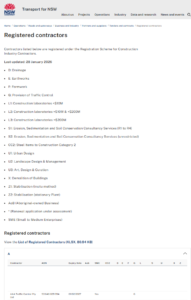
In NSW, Transport for NSW adds an extra layer of control through technical specifications and accreditation, such as G10 registration for traffic management providers.
Why is it important? Only accredited providers can manage traffic on certain classified roads, ensuring trained personnel and compliant equipment are used.
⛔What happens in its absence? Unqualified operators could manage high-risk sites, increasing the chance of incidents, liability disputes and project shutdowns.
5. Work Health and Safety (WHS) legislation
Traffic control standards operate alongside WHS laws, which require employers to eliminate or minimise risks so far as reasonably practicable.
Why is it important?This influences where barriers are placed, how close workers can be to live traffic and when additional protection like truck-mounted attenuators is required.
⛔What happens in its absence?Worker safety would rely on goodwill rather than legal responsibility, leaving people exposed to serious harm.
To summarise, these are not just rules, Australian traffic standards ensure that commuters know what to expect, projects run smoothly without last-minute changes, and Sydney authorities can approve and audit works confidently. Without them, traffic management would be inconsistent, confusing and unsafe for everyone involved.
Why These Standards Fit Our Conditions Here in Australia
Australia’s roads are not like those in Europe or North America. AAA Traffic Control experts emphasise that our conditions demand a different approach.
-
- We have long arterial and regional routes where speed and fatigue are real risks.
-
- We manage heavy freight, oversized vehicles and road trains daily.
-
- We deal with harsh sun glare, sudden storms and extreme heat that affect visibility and stopping distances.
That is why standards such as AS 1742 and the AGTTM are written specifically for Australian conditions. They are field-tested, adaptable, and designed to work optimally for any type of arteries in our country.
How Do Australian Standards Compare With Other Countries?
It is natural to ask whether international systems could work here. Many countries have strong traffic frameworks, but context matters. So, let’s do a short comparative analysis.
| Country | Primary Framework | Relevance to Australia |
| United States | MUTCD | Designed for federal highways with different speed and road geometry models. Effective nationally and varied across road layouts. |
| United Kingdom | TSRGD | Highly regulated signage system suited to denser networks and lower speeds. |
| Australia | AS 1742 & AGTTM | Purpose-built for long distances, mixed traffic and State-based approvals. |
This proves that Australian standards take global best practice and adapt it to our local realities. They are the most effective choice for traffic management in Sydney and across NSW.
The Role of Accreditation and Systems
Accreditations such as TfNSW G10 and management systems aligned with ISO 9001, ISO 14001 and AS 45001 demonstrate that traffic management processes are documented, audited and continuously improved. For project owners and delivery partners, this translates into greater certainty, traceability and risk control.
Our experts suggest you look into them during the nascent stages of your project.
Traffic Management is Ultimately About People
Australian Standards are the foundation of safe, efficient and defensible traffic control planning. They reduce risk, improve approval outcomes and protect both people and projects. And when combined with strong systems, local knowledge and experienced oversight, they become a powerful tool for delivering work with confidence.
Our team at AAA Traffic Control has delivered compliant traffic management in Sydney for over 20 years, completing more than 12,000 projects for government and private partners.
When you require an experienced traffic management consultant and end-to-end traffic management services, call us at (02) 9675 7731. Because, behind every standard is a human outcome.
FAQs
Q. Why is traffic control planning legally required in Australia?
Because road authorities and WHS laws require risks to be assessed and controlled wherever work affects live traffic or public access.
Q. Who is allowed to prepare a Traffic Guidance Scheme in Australia?
Only suitably trained and qualified traffic management professionals or traffic management consultants can prepare compliant TGS plans.
Q. What role does a traffic management consultant play?
A consultant assesses site risks, designs compliant plans and helps secure approvals from authorities.
Q. Who enforces traffic management standards in NSW?
Transport for NSW, local councils and SafeWork NSW all play roles in enforcement and compliance.
Q. What happens if your traffic control measures do not meet Australian Standards?
Your projects can be shut down, fines may apply and liability increases significantly if an incident occurs.