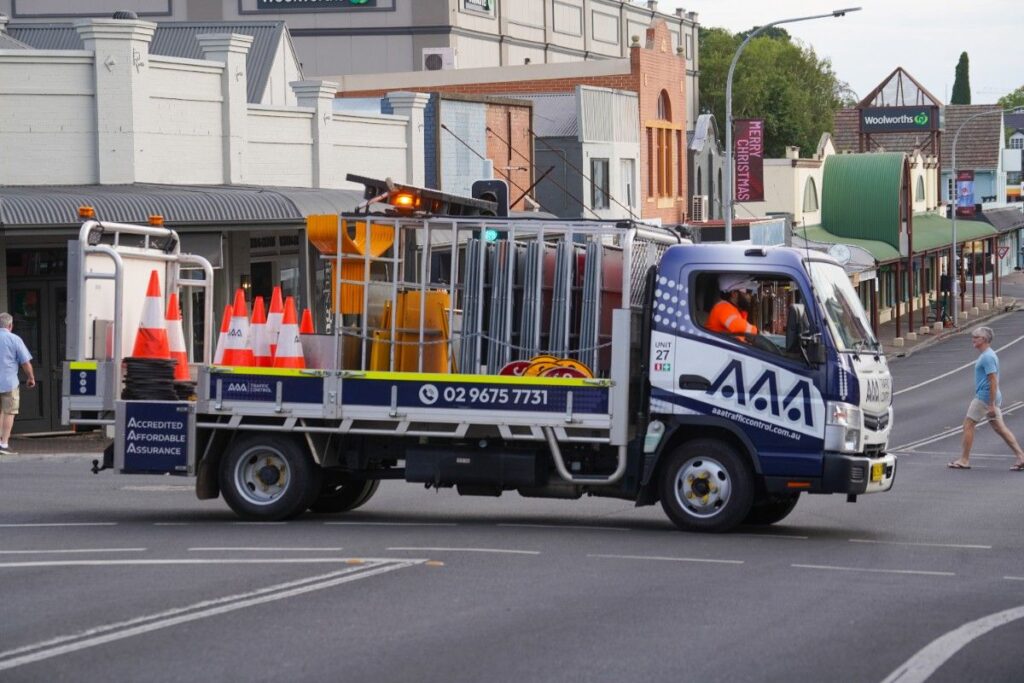
When you’re ensuring safety of thousands of runners, enabling a concrete pour on a high-rise, or resurfacing the Pacific Highway on a tight schedule, your process must remain compliant. TfNSW’s event classification, vehicle movement plans ,and zero-deviation preparedness is what a professional traffic company arrives with.
In this article, we take a look at three distinct sectors and learn how a traffic control company navigates around them.
1. When You’re Organising Community Events
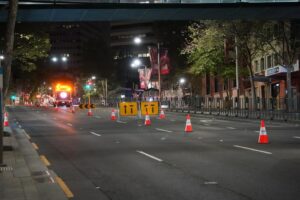
Community events like fairs, marathons, festivals and street parades bring people together, but they also introduce chaotic movement.
When you consult a traffic control company like ours for such events, we manage not just the cars, but also the public sentiments.
- TfNSW Event Classification & Early Planning: A professional traffic consultant will start by determining your event’s classification (Class 1 through 4) as defined by the TfNSW’s Guide for Special Events. This guide is your essential blueprint, providing the mandatory templates for the special event Transport Management Plan (TMP) that must be submitted to the local traffic committee.
- Active Hostile Vehicle Mitigation (HVM): For events involving large crowds, you should expect a heavy emphasis on Hostile Vehicle Mitigation (HVM), i.e., the use of physical barriers to prevent unauthorised vehicle entry.
- Proactive Community Liaison via VMS: An event should celebrate the community, not anger the residents who are blocked from their driveways. Expect your traffic control company to strategise the use of Variable Message Signs (VMS) in advance. It helps you warn road users of upcoming closures and ensure that alternative routes are clear.
2. When You’re Securing Productivity and Safety On-site
For property developers, construction companies, and utility providers, time is money. To support this, a professional traffic control company prevents costly ‘Stop-Work’ orders and hefty council fines.
Team AAA Traffic Control understands that the goal is efficiency maximisation and liability minimisation.
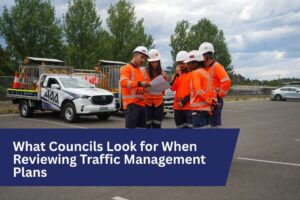
- Dynamic Traffic Guidance Schemes (TGS): In the ever-changing nature of construction sites, the setup that worked during the foundation pour will not work during the facade installation. You must possess site-specific Traffic Guidance Schemes (formerly called Traffic Control Plans) designed by an accredited person. This helps you meet the SafeWork NSW requirements.
- Seamless Logistics & Vehicle Movement Plans (VMP): The most complex part of a construction site is managing massive machinery entering and exiting small urban lanes. It demands coordinating concrete pumps, delivery trucks, and tower cranes. A Vehicle Movement Plan (VMP) ensures this heavy machinery doesn’t create gridlock on neighbouring arteries.
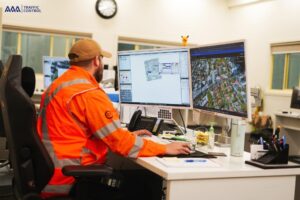
- Digital Compliance & ‘Duty of Care’ Logging: This is your primary legal defence. If there is an accident, you must prove you took all reasonable steps. Traffic control companies can help you with digital daily logs and incident reports that are timestamped and GPS–tracked. This acts as essential evidence of compliance to support you.
3. The Zero-Deviation Standard For Government Bodies
In this particular sector, a traffic control company is thoroughly evaluated. Working with TfNSW and local Councils requires a ‘zero-deviation’ approach. It must pass surprise audits and manage high-risk environments with precision.
- Zero-Deviation TCAWS Adherence: When your traffic control company sets up a site, there is no improvisation. Every sign’s position, every line marking, and every flashing arrow must be exactly as specified. The Traffic Control at Work Sites (TCAWS) Manual ensures just that.
- G10/G11 & Pre-Qualification Compliance: It is important to verify whether your provider is pre-qualified under the G10 (Traffic Management) and G11 (Environmental Management) categories or not. The NSW Government eTendering portal can help you check the credentials, ensuring they are authorised to work on state-level infrastructure.
- Road Occupancy Licence (ROL) & OPGate Management: It is extremely important to note that on State roads, work is only permitted within specific ROL windows (e.g., 10 PM to 4 AM). The primary expectation is that a traffic consultant must clear the road within the specified timeframe, or they may face severe fines for obstructing the high-volume road network. Additionally, the traffic control company you hired must be experienced in managing the ROL application through systems like OPGate.
To Summarise
It is clear that planning community events, managing construction projects, and ensuring compliance for government organisations is much more than just signage work.
And before we conclude, let’s quickly revisit what is needed to address dynamic challenges across various sectors in NSW.
| Aspect | Community Events | Construction | Government |
| Primary Goal | Public Safety & Experience | Productivity & Risk Control | Regulatory Precision |
| Key Framework | TfNSW Classification & TMP | Dynamic TGS | TCAWS Zero-Deviation |
| Core Plan | Special Event TMP | TGS & VMP | TCAWS Setup Records |
| Top Tools | VMS & HVM Barriers | VMP & Digital Logs | AFADs, TMAs, OPGate |
Choose AAA Traffic Control For Maximum Results
The proficiency of handling these challenges is seen through the expertise of a professional traffic control company. We understand that safety is not just an outcome, it’s a system.
AAA Traffic Control bridges the gap between complex regulation and on-the-ground execution, which is why we proudly boast having executed 12,000+ projects, supporting partners like you.
To know more about how AAA Traffic Control ensures everything’s green and good to go, learn more about our services and call us at (02) 9675 7731.
FAQs
Q. What is the difference between a TMP and a TGS?
A Traffic Management Plan (TMP) is a high-level strategic document for major projects, while a TGS is the tactical, on-ground layout of equipment for a specific workday.
Q. Why are Truck Mounted Attenuators/TMAs required?
TMAs are crash cushions on the back of the trucks. When overlooking high-speed roadworks, they help you absorb impact if a motorist enters the work zone.
Q. How many traffic controllers do I need for a simple lane closure?
Requirements vary by road speed and visibility. A standard lane closure usually requires a minimum of two controllers to manage and execute the ‘Stop/Slow’ transition safely.
Q. Can traffic control help with pedestrian management?
Absolutely. Professional marshals are trained to manage high-volume pedestrian movement, ensuring accessible paths of travel are maintained for people with disabilities during works or events.
Q. What is the penalty for working without an approved ROL?
In 2026, working without an ROL or overstaying your window on a State road can result in fines possibly exceeding $2,500 per 15-minute increment, as it disrupts the broader Sydney transport network.