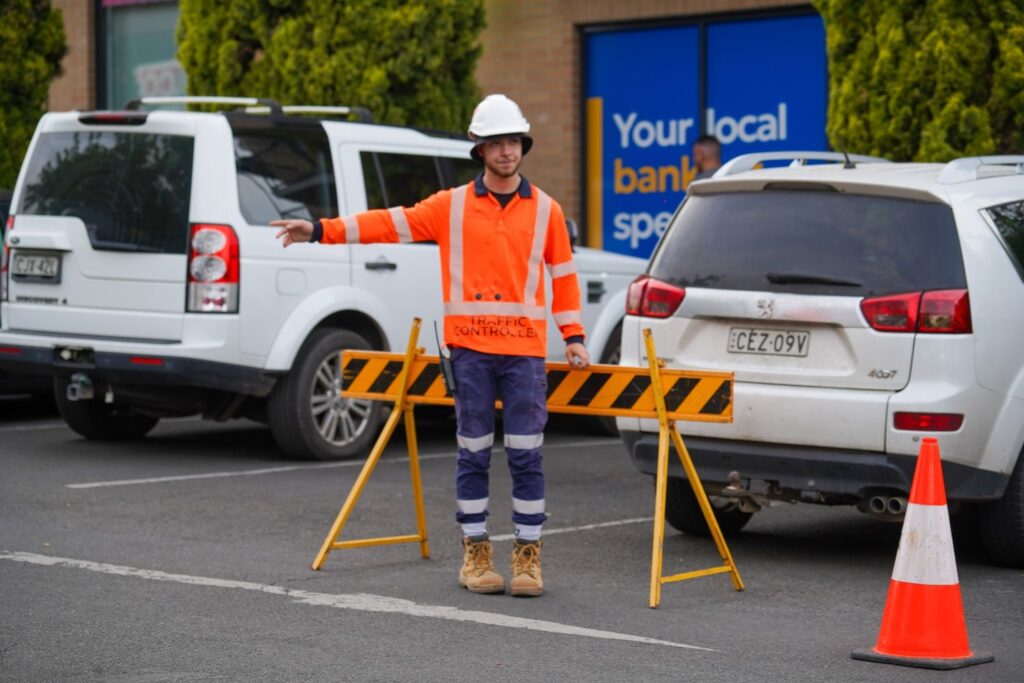
Moving from a culture of warnings to a culture of immediate enforcement, a professional traffic control company is your legal shield and the first line of defence today. Let’s see why you’d need traffic controllers to ensure safety in challenging environments and handling aggressive elements.
What is TFNSW?
Think of Transport for NSW (TfNSW) as the brain and nervous system of the state’s movement.
Established in 2011 to consolidate fragmented road and rail authorities, it is the lead government agency responsible for the strategy, planning, and safe operation of all transport modes in New South Wales. This includes the ferries in the harbour to the highway you’re driving on.
TfNSW’s Traffic Control at Work Sites (TCAWS) Manual is important to refer to here:
- This manual is the holy grail of road safety as it dictates every minute detail of a site setup.
- It includes aspects like how many meters a ‘Roadwork Ahead’ sign must be from a lane taper, the specific brightness of an LED arrow board, and how a controller should stand to remain visible to a driver even at 100km/h.
The accredited TfNSW traffic controllers here are trained specifically to implement such high-level standards. Let’s learn more about the accreditation advantage through 4 diverse environments.
1. High-Speed Lane Merges (80km/h Zones)
When closing a lane on a high-speed arterial road, physics and timing are everything.
- With Accredited Traffic Controllers: They implement a precise Traffic Guidance Scheme (TGS) with scientifically calculated taper lengths. Signs and cones are placed at exact intervals to give drivers enough reaction time to merge without panic braking.
- Without Accredited Traffic Controllers: Tapers are often too short, or signs are poorly placed. Drivers see the hazard too late, leading to swerving and high-speed near-misses.
The Consequence: A multi-vehicle pile-up. Beyond the immediate tragedy, you also face a SafeWork NSW investigation and potential Industrial Manslaughter charges if negligence in site setup are indeed proven.
2. Busy School Zone Pedestrian Management
Managing a utility repair near a school gate during the 3:00 PM rush is a high-pressure environment.
- With Accredited Traffic Controllers: They prioritise vulnerable road users, using specific stop-slow rhythms to create safe gaps for children while keeping site machinery completely isolated.
- Without Accredited Traffic Controllers: An untrained worker may focus only on the cars, losing sight of a child crossing behind a truck or in a blind spot.
The Consequence: Massive public liability. If a pedestrian is injured, your insurance policy will likely be voided because you failed to use competent, certified personnel for high-risk construction work.
3. Coordinating Heavy Plant & Reversing Machinery
In 2026, most major projects must follow CLOCS-A (Construction Logistics and Community Safety – Australia) standards for heavy vehicle interaction.
- With Accredited Traffic Controllers: They act as professional spotters who understand vehicle blind spots and use standardised hand signals. They ensure exclusion zones are physical realities, not just lines on a map.
- Without Accredited Traffic Controllers: Workers and machinery mix haphazardly. A reversing truck might clip a labourer or another vehicle because the person guiding it didn’t understand the swing radius.
The Consequence: Immediate Road Occupancy Licence (ROL) revocation. TfNSW can ban your company from working on state roads for months, stalling your project and costing you thousands in daily holding fees.
4. Managing Aggressive Public Interactions
Traffic congestion in 2026 is at an all-time high, and driver frustration frequently boils over into road rage.
- With Accredited Traffic Controllers: They are trained in psychosocial hazard management and de-escalation. They know how to remain calm, use professional radio protocols, and report incidents without escalating the conflict.
- Without Accredited Traffic Controllers: An untrained worker may argue back or feel traumatised by the abuse, leading to a volatile site environment.
The Consequence: A Psychosocial Safety Claim. Under the 2026 Road Safety Action Plan, TfNSW no longer accepts that human error (by drivers or workers) should lead to death or serious injury. Because of this, the agency has recently updated the TCAWS standards to be more rigorous than ever.
How AAA Traffic Control’s Accreditation Fits Here
Partnering with AAA Traffic Control means your site is managed by traffic controllers who have already passed the most rigorous vetting in Australia. Our accreditation isn’t just quality assurance, it’s a comprehensive response system to address dynamic challenges for you.
- TfNSW G10 Prequalification (The Gold Standard)
It’d be reassuring knowing that AAA Traffic Control holds the TfNSW G10 Prequalification, an essential requirement for working on major NSW road networks.
- This status confirms that TfNSW has already audited our technical expertise, financial stability, and safety history.
- G10 prequalification is often a mandatory prerequisite for Tier 1 and Tier 2 construction tenders, which readily makes us contract-ready.
- It guarantees that our Traffic Management Plans (TMPs) and Traffic Guidance Schemes (TGSs) meet the strict TCAWS standards.
- Our ISO Triple-Crown (9001, 14001, 45001)
We maintain an integrated management system certified to international standards, providing a legal shield for your project.
- The ISO 45001 (Safety) standard empowers our staff to handle site stress and public aggression.
- The ISO 9001 (Quality) standard guarantees consistent, error-free documentation for every audit.
- The ISO 14001 (Environment) standard ensures your roadworks comply with modern environmental protections, minimising your project’s ecological footprint.
- Full-Service Compliance
It’s not just equipping you with an expert team we are proud of, it’s about full compliance management in our operations.
- We have fully equipped fleets (including CLOCS-A compliant vehicles) ready for emergency call-outs across NSW.
- We manage the ROL and council approval process, liaising directly with TfNSW and local authorities.
- 100% of our staff hold SafeWork NSW/TfNSW cards (Blue, Yellow, and Red equivalents), promising certified expertise at any hour for any situation.
By fulfilling these through a wide range of services, we offer the peace of mind you deserve. Feel free to verify AAA Traffic Control’s full list of certifications and share your expectations at info@aaatc.com.au or (02) 9675 7731.
FAQs
Q. What are the penalties for using unaccredited traffic staff?
As of 2026, corporations can face fines exceeding $21,000 per incident, while site supervisors can be personally fined. Repeat offences may result in project shutdowns or the loss of your builder’s license.
Q. Who is liable if an accident occurs at my work site?
Liability is shared. However, if you fail to hire accredited controllers, the primary burden of proof falls on the site manager to explain why “reasonably practicable” safety measures (hiring certified pros) were ignored.
Q. Why is TfNSW G10 Prequalification important for my tender?
G10 is a financial and technical stamp of approval. Most government and Tier 1 contracts mandate that traffic providers hold G10 status to ensure they have the capacity and safety systems to handle complex projects.
Q. What does CLOCS-A compliance mean for my site?
CLOCS-A is the national standard for heavy vehicle safety. It requires traffic controllers to manage “vulnerable road users” (cyclists/pedestrians) and ensures that all construction trucks have specific safety tech like side guards and blind-spot cameras.
Stay Updated with AAA Traffic Control
Make AAA Traffic Control a preferred source on Google for relevant traffic management insights, industry updates and useful information.