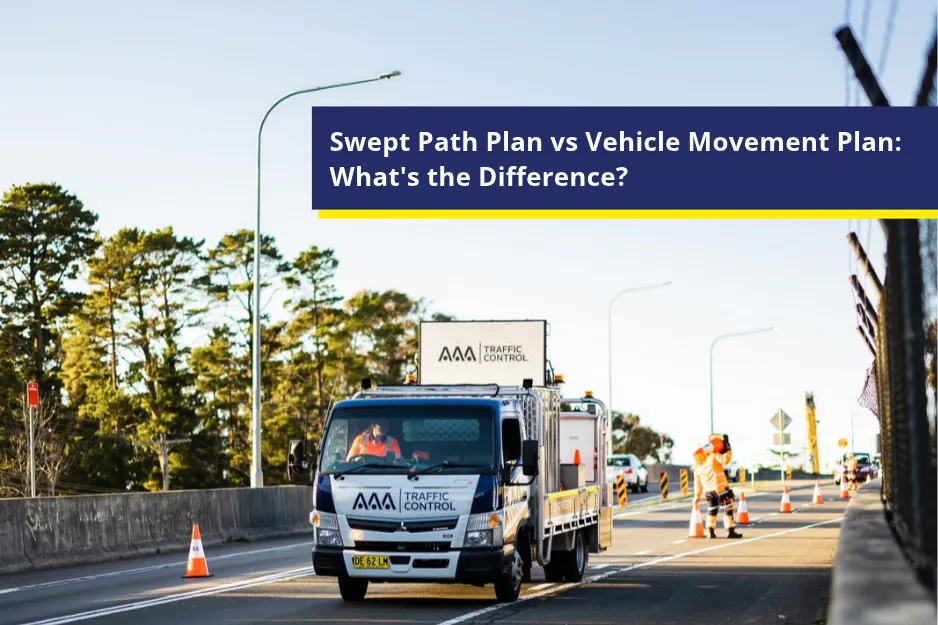
In simple words, a Swept Path Plan proves our vehicles can physically turn, enter and leave a site without striking anything. A Vehicle Movement Plan, on the other hand, sets out how all other vehicles, pedestrians and traffic controllers will operate safely around it. NSW councils often expect both.
However, often a question arises: swept path plan vs vehicle movement plan- are they the same? Which one comes first? Why do they answer two different questions, and how can mixing them up stall a submission? Through this blog, AAA Traffic Control experts explain it all to stakeholders working around NSW’s road network.
1. What Is a Swept Path Plan?
A Swept Path Plan is a scaled drawing showing the ground a vehicle covers as it turns, including its body, wheel tracks and rear overhang. It is drawn over your site or road plan using simulation software, so the vehicle is tested before a slab is poured or a gate is hung.
The designer nominates a vehicle, such as a heavy rigid truck, a semi-trailer or the council’s waste truck, and AS 2890.2:2018, the standard for off-street commercial vehicle facilities, guides the assessment.
If you ask us, reviewers typically look for a clearance buffer around the path, and for vehicles to enter and leave. Additionally, Sydney’s standard CTMP requirements ask for the swept path of the longest vehicle entering and exiting the site.
2. What Is a Vehicle Movement Plan?
A Vehicle Movement Plan shows how vehicles travel around a site or event from arrival to departure. It marks entry and exit points, haul routes, loading zones, turning areas, pedestrian crossings and where traffic controllers will stand.
Where a swept path drawing tests one manoeuvre, this plan covers the whole operation, including timing, staging and people. Sydney Metro’s construction traffic management plans pair vehicle movement plans with pedestrian movement plans.
Need a Swept Path or Vehicle Movement Plan?
AAA Traffic Control can help →3. Why NSW Projects Need Both
Each plan covers what the other doesn’t. For instance, a Swept Path Plan can show a heavy rigid truck clearing your driveway, yet say nothing about schoolchildren walking past at 3pm. In this case, a Vehicle Movement Plan can organise deliveries neatly, yet rest on a turn the truck cannot make.
Together they usually sit inside a Construction Traffic Management Plan or CTMP, which councils commonly require for work touching a road, footpath or verge.
Any traffic guidance scheme in that package must be prepared by someone holding the Prepare a Work Zone Traffic Management Plan (PWZTMP) qualification.
🚧 AAA Traffic Control Insights: TS 05492:1.0 TCAWS from TfNSW was published in June this year. It replaces the earlier 6.1 technical manual where speed limits remain updated and any plan citing the old manual may need rework.
4. Swept Path Plan vs Vehicle Movement Plan at a Glance
| Site Factor | Swept Path Plan | Vehicle Movement Plan |
| Primary concern | Can the vehicle physically fit and turn? | How will vehicles and people move safely? |
| Format | Scaled drawing over a site plan | Plan showing routes, staging and controls |
| Covers | Turning paths, clearances, entry and exit | Routes, loading, pedestrian movements and traffic controls |
| Typical use | Development conditions, driveways and loading docks | Construction sites, events and work zones |
| Usual place in documentation | Appendix to a CTMP | Section of a CTMP or TMP |
5. AAA Traffic Control Can Prepare Both for You
At AAA Traffic Control, we design Swept Path Plans, Vehicle Movement Plans, Traffic Management Plans and Traffic Guidance Schemes as one coordinated package. Our accredited project managers utilise the latest tools to inspect your site and assess your proposed vehicle routes before anything is lodged.
We also handle permit applications, including TfNSW road occupancy approvals and council permits, so your plans reach the right authority in the right form. Once approved, our accredited traffic controllers put the plan into action on site, and our traffic control equipment for hire covers signs, barriers and portable devices.
Lastly, we are TfNSW G10 certified, with over 160 years of combined industry experience and more than 200 accredited professionals headed by Amir Imam. Our clients include Sydney Water, John Holland and Laing O’Rourke, and our traffic control Sydney services cover the metropolitan area and greater NSW.
If you need help with any of the services revolving around NSW, call (02) 9675 7731 for Sydney’s best minds on everything revolving around traffic management.
FAQs
Q. Is a swept path plan the same as a vehicle movement plan?
No. A swept path plan tests whether a vehicle can physically fit and turn. A vehicle movement plan explains how vehicles, people and controls work together over time. Many NSW projects need both, usually inside a construction traffic management plan.
Q. Do vehicles need to enter and leave a site in a forward direction?
Councils indeed require the nominated vehicle to enter and leave in a forward direction, especially on busy roads. If reversing is unavoidable, expect closer scrutiny and a requirement for a clear plan to manage it.
Q. Do events need a vehicle movement plan?
Events bring deliveries, suppliers, buses and crowds into the same space, so a vehicle movement plan helps organisers manage access, parking and pedestrian safety. Requirements depend on the event, the location and the approving authority.
Q. Do I need a road occupancy licence or council permit as well?
Work affecting a state road generally needs a Road Occupancy Licence from Transport for NSW, while local roads usually need council approval. For a standard ROL, we suggest allowing at least 10 working days, plus time to prepare the application. Call us on (02) 9675 7731, and we will confirm which permits your project needs.
Q. Why might a council reject or query a swept path plan?
Common reasons include testing a smaller vehicle than the one that will actually arrive, tight or missing clearances, wheels crossing kerbs or opposing lanes, drawings that do not match the site plan and unexplained reversing movements. Fixing these before lodgement saves time.
Stay Updated with AAA Traffic Control
Make AAA Traffic Control a preferred source on Google for relevant traffic management insights, industry updates and useful information.