Traffic control plays a critical role in keeping workers and road users safe during construction, maintenance and utility works across New South Wales. Whether works involve civil construction, stormwater maintenance, service connections or road upgrades, proper traffic management is essential to ensure sites operate safely and remain compliant with regulations.
In NSW, traffic management on public roads must be carried out by companies that hold the appropriate accreditation from Transport for NSW. One of the most important accreditations for traffic control providers is Category G Traffic Control accreditation.
For contractors and project managers, understanding what Category G accreditation is and why it matters can help avoid compliance issues and reduce risk on site.
What is Category G Traffic Control Accreditation?
Category G accreditation is issued by Transport for NSW and allows a company to legally implement traffic control at worksites on public roads.
This accreditation forms part of the Traffic Control at Work Sites framework used across NSW. It ensures that traffic management providers meet strict safety, operational and training requirements before they are permitted to operate on public roads.
To obtain Category G accreditation, a traffic control company must demonstrate that it has qualified traffic controllers, compliant equipment, appropriate insurances and documented operational procedures. Accredited companies must also maintain these standards and comply with Transport for NSW requirements on an ongoing basis.
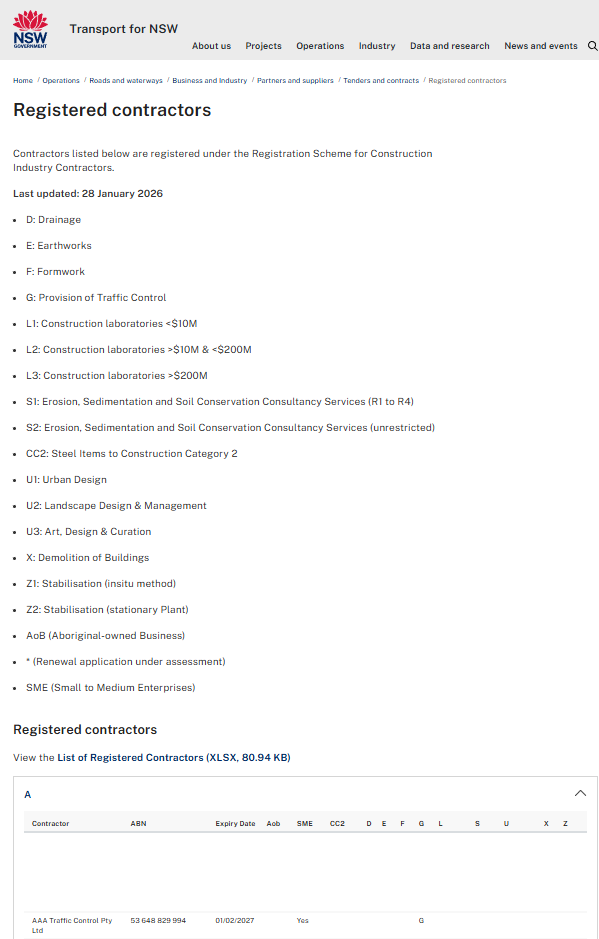
Further information about the accreditation framework can be found on the
Transport for NSW Registered Contractors page to view click here.
Is Category G Required for Traffic Control in NSW?
In most situations where traffic control is required on public roads, the company implementing the traffic management must hold Category G accreditation.
This applies to many types of work carried out across Sydney and regional NSW including civil construction, utility works, stormwater maintenance, pit repairs, roadworks and infrastructure upgrades.
Without Category G accreditation, a company may not be authorised to carry out traffic control on public roads.
What Happens if a Non Accredited Company Carries Out Traffic Control?
Using a traffic control provider that does not hold Category G accreditation can create serious compliance and safety risks.
Transport for NSW requires traffic control on public roads to be implemented by accredited providers. If a non accredited company sets up traffic control, this may result in defect notices, instructions to remove the traffic control setup or even a shutdown of the worksite until compliant arrangements are in place.
Project delays can quickly follow, particularly on civil and utility works where traffic management is required for the work to proceed.
There are also liability risks to consider. If an incident occurs where traffic control has been carried out by a non accredited company, responsibility may extend beyond the traffic control provider. The principal contractor, project manager or client may also be exposed to risk depending on the circumstances.
Insurance providers may also question claims where traffic management was not implemented by an appropriately accredited company.
Most importantly, poorly implemented traffic control can increase safety risks on site. Traffic management requires trained personnel, correct equipment and proper planning to ensure vehicles, pedestrians and workers are protected within the work zone.
Category G Accreditation Can Be Revoked
Category G accreditation is not a once off approval that lasts forever. Transport for NSW actively monitors accredited providers and expects companies to maintain compliance with operational and safety requirements.
If a traffic control provider repeatedly fails to meet these standards, their accreditation can be suspended or revoked.
This can occur if companies do not follow approved procedures, fail audits, or repeatedly implement traffic control setups that do not comply with Transport for NSW requirements.
For contractors and clients, this highlights why it is important to engage traffic control providers that operate professionally and maintain strong compliance systems.
Long Standing Category G Accreditation
Category G accreditation has existed in NSW for more than two decades and forms part of the contractor registration framework originally introduced under the Roads and Traffic Authority, now Transport for NSW. The program was established to ensure companies carrying out traffic control on public roads meet consistent safety, training and operational standards.
AAA Traffic Control has held Category G accreditation since the company was established in 2003. Over that time our team has supported a wide range of civil construction, utility and infrastructure projects across New South Wales while maintaining compliance with Transport for NSW requirements.
Maintaining accreditation for such a long period requires companies to continually meet operational standards, maintain trained personnel and operate under compliant traffic management procedures.
Why Using a Category G Accredited Traffic Control Company is Important
Engaging a Category G accredited traffic control company helps ensure traffic management is implemented in accordance with Transport for NSW requirements.
Accredited providers operate under documented procedures and training frameworks that support safe worksite operations. This reduces risk for contractors and clients while helping ensure projects remain compliant.
Experienced traffic management providers also understand how to maintain traffic flow around worksites while still protecting the safety of workers and road users.
Category G Traffic Control Services in NSW
AAA Traffic Control is a Category G accredited traffic control provider operating across New South Wales. Our team supports civil contractors, utility providers and infrastructure projects with compliant traffic management services.
We regularly provide traffic control for works including civil construction, utility maintenance, pit works, roadworks and infrastructure upgrades. Our crews are experienced in working within busy road environments and understand the operational requirements involved in keeping worksites safe and compliant.
Experience Matters in Traffic Control
While many companies provide traffic control services, experience and compliance systems play a major role in maintaining safe and effective work zones. Traffic management often needs to be implemented in complex environments including busy arterial roads, local streets, utility corridors and infrastructure projects. Providers with long standing experience in these environments are typically better equipped to plan and deliver traffic control that meets Transport for NSW requirements while keeping projects moving efficiently.
AAA Traffic Control has been providing traffic management services across NSW for more than two decades and holds Category G accreditation with Transport for NSW. Our team regularly supports civil contractors, utility providers and infrastructure projects throughout Sydney and regional NSW.
AAA Traffic Control has been providing compliant traffic management services across NSW since 2003.
Looking for Category G Traffic Control in NSW?
If your project requires traffic management on public roads, working with a Category G accredited provider is essential.
AAA Traffic Control provides experienced crews, compliant equipment and reliable traffic management services across NSW.
If you have upcoming works that require traffic control, our team would be happy to assist.